Why Your Caloric Baseline Matters
Tell us if this sounds familiar. You decide that you want to lose a little bit of weight. You research different diets and decide to follow one that creates caloric restriction of, say, 500 calories per day. You repeat this daily for a few weeks and you lose some weight. Hey look at that. Nice going. But then, after a few more weeks you quickly plateau and maybe even find yourself mysteriously retaining more body fat than when you first started.
Here’s a white hot take: It is very often underfeeding, not overfeeding, that plagues most active people who try and lose weight. They restrict calories on an already calorie restricted body, further disrupting the natural order of their hormones, have too many catabolic and not enough anabolic hormones and have sent their metabolism into a tailspin.
Let’s take Jamie, a 5’6″, 155 pound female who is moderately active and is 25% body fat. Her typically calorie intake should sit around 1,800 – 1,900 calories per day in order to maintain her current body composition. While Jamie needs to be at 1,800, she is in all reality probably closer to 1,200, creating a chronically disturbed endocrine environment that is primed to store fat instead of burn it.
Now let’s say that Jamie wants to lose weight and cuts calories. Not realizing that she is already in a chronic caloric deficit, she cuts even harder in the attempt to stimulate fat loss. She isn’t really tracking or counting what she eats, she just reads that she needs to cut calories for weight loss, so cut she does, and she notices in the first couple of weeks that she’s down three pounds. Because she is so encouraged by her initial weight loss (that is very likely muscle and water, not fat), she decides to cut a little bit more, and a little bit more. After a few more weeks, her initial weight loss (again, muscle and water) stops and she flat lines.
Jamie decides she’s over it, and goes on a binge, no longer eating 1,000 calories but is now eating a whopping 1,600! Even though she should be able to handle 1,800 just fine, Jamie puts on weight very quickly. The initial weight that she lost is quickly re-gained, and, her weight keeps going above where she started. Her “diet” not only didn’t result in weight loss, it produced weight GAIN.
How?! Why?!
I present to you, the vicious circle of chronic underfeeding:
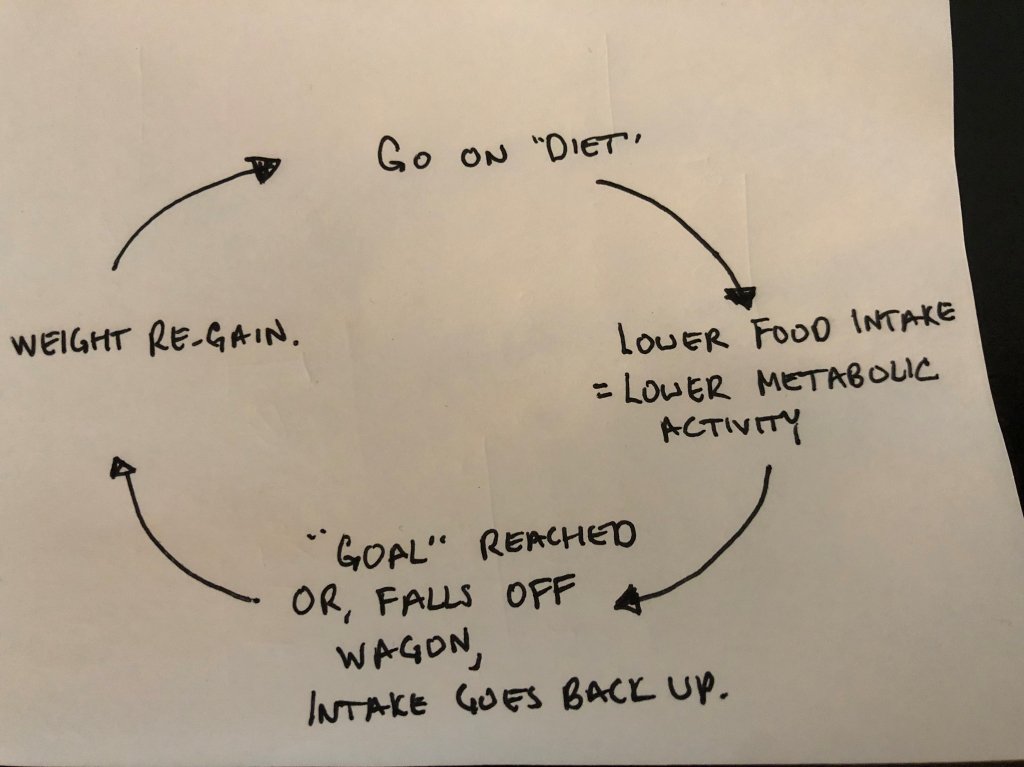
The “Weight Re-Gain” phase I mentioned occurs for two reasons.
- Jamie’s body has adapted to her lowered caloric intake over time. It has decided to burn less calories because it is interested in not dying, so it’s matched her low input with low output. This low output essentially re-wires Jamie’s Resting Metabolic Rate. Where at normal levels she should be consuming 1,800 per day, she is consuming 1,200 so her RMR down regulates to that level.
- When she goes to eat at the appropriate level (1,800), she gains weight. Her RMR is not primed to handle “all of those calories” and the weight shoots back up.
- She decides to fix that weight gain with a reduction of calories. Again.
AKA The Vicious Cycle of Chronic Underfeeding.
The only way to step out of the cycle is to spend time establishing your proper maintenance baseline, and existing there for at least a month. This is a big, big concept Coach Ashley establishes with our nutrition students. Cutting does not always mean fat loss. In most cases, unless a proper length of time is spent creating a baseline before the cut, the caloric deficit can result in more weight than before you started.
Eat. Set your daily caloric baseline. Let magic happen there, and then and only then, MAYBE consider either a surplus or deficit.