

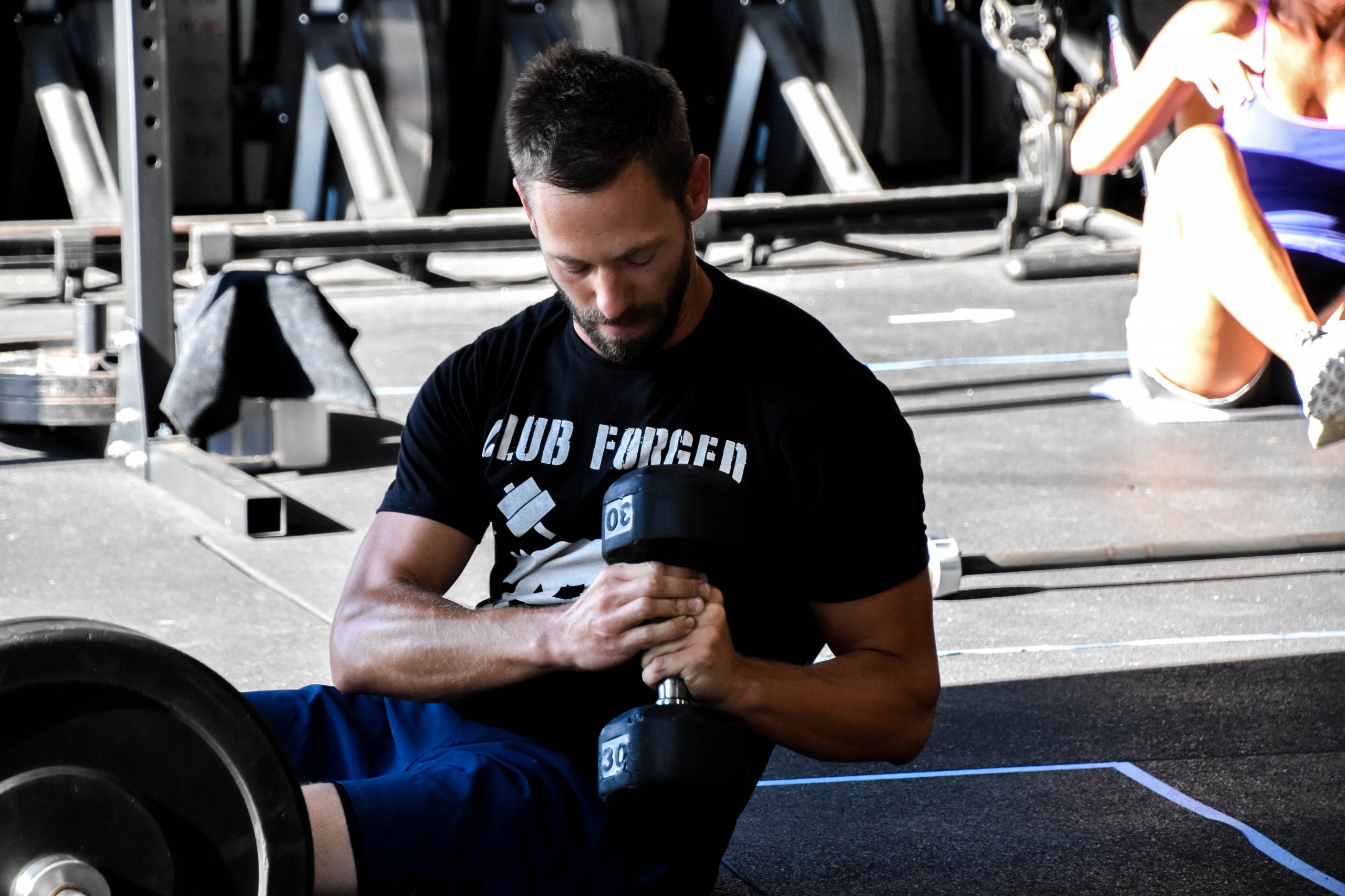
Genetics Are a Thing, Embrace It
It is very common for folks with high trainability to get very defensive when genetics are brought up, quickly citing that it’s been all the hard work that’s caused the progress. No doubt. However, regardless of how much it might bruise their image of their own hard work, genetics are a thing and they are absolutely, positively, unequivocally a variable in the equation. A fixed variable, in fact. It’s why some people can boast about eating donuts and still look shredded while others may as well tape it directly onto their midsection.
The point of this article is not to empower you with an excuse to use your genetics as a reason why you can’t X, Y, and Z. Just as those with alcoholism in their family can manage to avoid the same fate as their drunk fathers, so too can you achieve great physical change but I am always a fan of knowing what cards you have and what cards you don’t.
Factors such as leverage characteristics of one’s joints, distribution of fast and slow twitch muscle fibers, acid buffering capability, body somatotype, bone girth, and others are all genetic input that play a vital role in your training output. These influences make up what’s referred to as your Genetic Trainability.
It’s a nice way of saying your ceiling. We all have one. They’re all different.
Here are a couple major aspects of genetics to consider.
Enduring vs. Powerful
In Kill Bill 2, there’s the scene where Bud is talking to Elle in the desert trailer. He asks her, now that Beatrix is supposedly dead, which ‘R’ she is filled with more? Regret or relief? At first, Elle says both and Bud responds by saying he understands, and that both are to be expected, but as he says, “I know damn well you’re filled with one more than the other, so which is it?”
Think about your athletic tendencies in similar manners. Very few of us are rarely put into a silo for whether or not we are powerful or enduring, but we all skew more towards one the other. There are athletes who are more genetically wired for power, and there are athletes that are more genetically wired to endure. Both will progress, but at much different rates, benefits, and outcomes. Take a former football linebacker and a college distance runner and put them on the same lifting program, and you’re going to get two drastically different outcomes.
Lance Armstrong is an example of a human being who born out of the womb with the ability to endure better than 99.99% of us. For starters hsis resting heart rate is absurdly low, once clocking in at 32 beats per minute. That is…insane. And it’s not something you or I could EVER achieve.
Work on both skill sets, but know that you likely have a far greater ceiling in one versus the other.
Body Somatotype
Thigh, pelvic, and calf girth all directly correlate to strength potential (1). These characteristics create larger loading frames so they can produce more force, handle and move larger loads, and be less prone to injury and training stresses. However, that same body type is likely not going to crank out a five minute mile. There are strengths and weaknesses to us all.

- Endomorphs – Bigger, wider hips, usually gain weight easily. Tend to favor power activities and produce much higher strength and power outputs.
- Mesomorphs – Broad shoulders with relatively narrow hips. Usually all around very athletic. Tend to be proficient in both power and enduring. These are the all-rounders.
- Ectomorphs – Thinner, narrow hips, usually hard gainers who struggle to put on weight. Tend to genetically favor enduring activities. These are very hard gainers.
Put those who are hardwired to endure in a program where they can train and express it, and you’re usually talking about distance race champs. Put those who are hardwired to produce power in a strength and endurance format, and you’re usually looking at fitness competition winners. Put those who are hardwired to produce high-end power and you’re looking at lifting medalists. Have narrow bones and I’m sorry, but your strength potential is inherently limited versus those who have bigger bones. But the good news is that when zombies attack you’ll be able to outrun them.
Length of Joints
Anthropometry is the study of measurements and proportions of the body, and it plays a very large role in both the mechanics of a movement and the ability of the athlete to produce force. If you are short and have short limbs you are going to crush weightlifting movements because the bar doesn’t have to travel as far, and you’ll need to produce less mechanical torque.
Here’s an example that is impossible to dispute: the person with long arms.
If you have long arms you’ll be great at deadlifting because the weight does not have to move very far off the ground, but, it’s going to make bench pressing for that person more difficult because the bar has to travel further to lockout. Yin and yang. Pro and con. Good and bad.
Here’s another.
If you have long femurs and a short torso, you’ll likely be good at deadlifting, but the squat is going to be a challenging movement pattern and you’re not going to squat ass-to-grass. Coach Ashley is an excellent example of this. She has pulled an impressive 300# pound deadlift but she always has a hard time expressing what most visuals would describe as a textbook bodyweight squat. Her legs just don’t want to move into that position.
Ultimately, there are two main reasons to be aware of your trainability.
- Appropriate Movements – If you know you are never going to have great leverage in the conventional deadlift and a bit more susceptible to injury, take a look at the sumo stance. If you have very long femurs and tend to naturally tip forward in your squat, try squatting high bar to keep a more vertical torso.
- Expectation Management – I see so much comparison in the gym, which I usually believe to be a net positive. However, when we start to say, “Well I see him doing that weight all the time and I’ve been training for two more years!” Trainability, friends.
Genetics don’t mean you can’t get strong and fit as hell, and they certainly do not define your fitness outcomes. Just look at our own Brie Hancy. Scoliosis in her back, yet once placed 5th at USA Powerlifting Nationals. Coach Kyle, who fits the thigh, pelvic, and hip girth power mold has also produced a sub 6-minute mile. You can train to strengthen any movement to a very high level, and anyone can get into great shape and develop high outputs of fitness measureables with hard work.
However, knowing where and what you naturally favor can be helpful towards managing your expectations, helping you select appropriate goals, and keep the gym a place of net happiness for you as opposed to a place of frustration born out of misunderstanding.
-Dave
Thursday, 10.22.20
PSC
First:
6 Bench Press
4×3 RKB Swings
(x16 Min)
Then:
6 Supine Rows
10 SA Step Downs
5 MB Slams
150m Run EOR
(x14 Min)




Leave A Comment
You must be logged in to post a comment.