A Friendly Reminder to Dropkick Your Scale
The scale is great for weighing things. If you were a shipping container, the scale would be awesome. However, ask yourself why you want to know only your net weight? Why do you care about that total number? Is it because it’s driving your perception of your results? Is it because it’s an antiquated tool from days or yore we’re just addicted to? After all, doesn’t the break down of how that weight is comprised matter? If I have two hundred pounds of various metal, wouldn’t I want to know if some of that is gold versus rusted scrap?
Where the scale fails you is in that breakdown.
Instead of the scale, I am insisting that you adopt one of two alternatives.
1. Measure Subjectively
More often than not I’ve witnessed them turn otherwise sane and logical people into obsessed freaks who weigh themselves eighteen times a day until they finally lose it and quit. This is fucking tragic. Because so many people quit when they are actually making progress!
For example, it is very common for a member to burn seven pounds of body fat in their first three months while adding four pounds of muscle. Because stimulus is new, beginners can pull off adding muscle and burning fat at the same time. If one were to base their progress off the scale, they might see a net decrease of “just” 3 pounds and be disappointed. However, in reality the results are much more profound, dropping 7 pounds of unhealthy tissue (fat) and replacing it with 4 pounds of healthily tissue (muscle). This is a tremendous initial success and what happens to the vast majority of people in a program that contains strength and conditioning.
Your body can fluctuate as much as three to five pounds in a given day just by regular metabolic processes, glycogen depletion and replenishment, water weight retention and menstruation if you are a woman. So, if you weighed yourself on Monday morning and read 170 you could very easily go back that very same night and have it read 175.
Would you honestly believe you put on five pounds of fat in 12 hours while maintaining an intense exercise program?
The much better solution is to track other data points. How do you feel? How much energy do you have? How do you carry yourself? How do you fill out your clothes? Are jeans tighter around the butt and legs but not around the waist? That means you’re adding muscle, not fat, and that’s a good thing.
If you are the analytical type who needs the sanity of data, then there is a solution.
2. Measure Better
The scale tells us nothing of how we are re-composing our body to contain more muscle and less fat, and I can’t tell you how many times people are astonished at their results when they start measuring it with something that provides an actual breakdown of what’s really happening.
If you like to measure, the indisputably superior alternative would be the InBody machine at Crown Point. Or the machine “with the weird handles”, as member Bill Byrne so eloquently put when talking about his dramatic transformation. You will get a far more accurate picture of what’s going on.
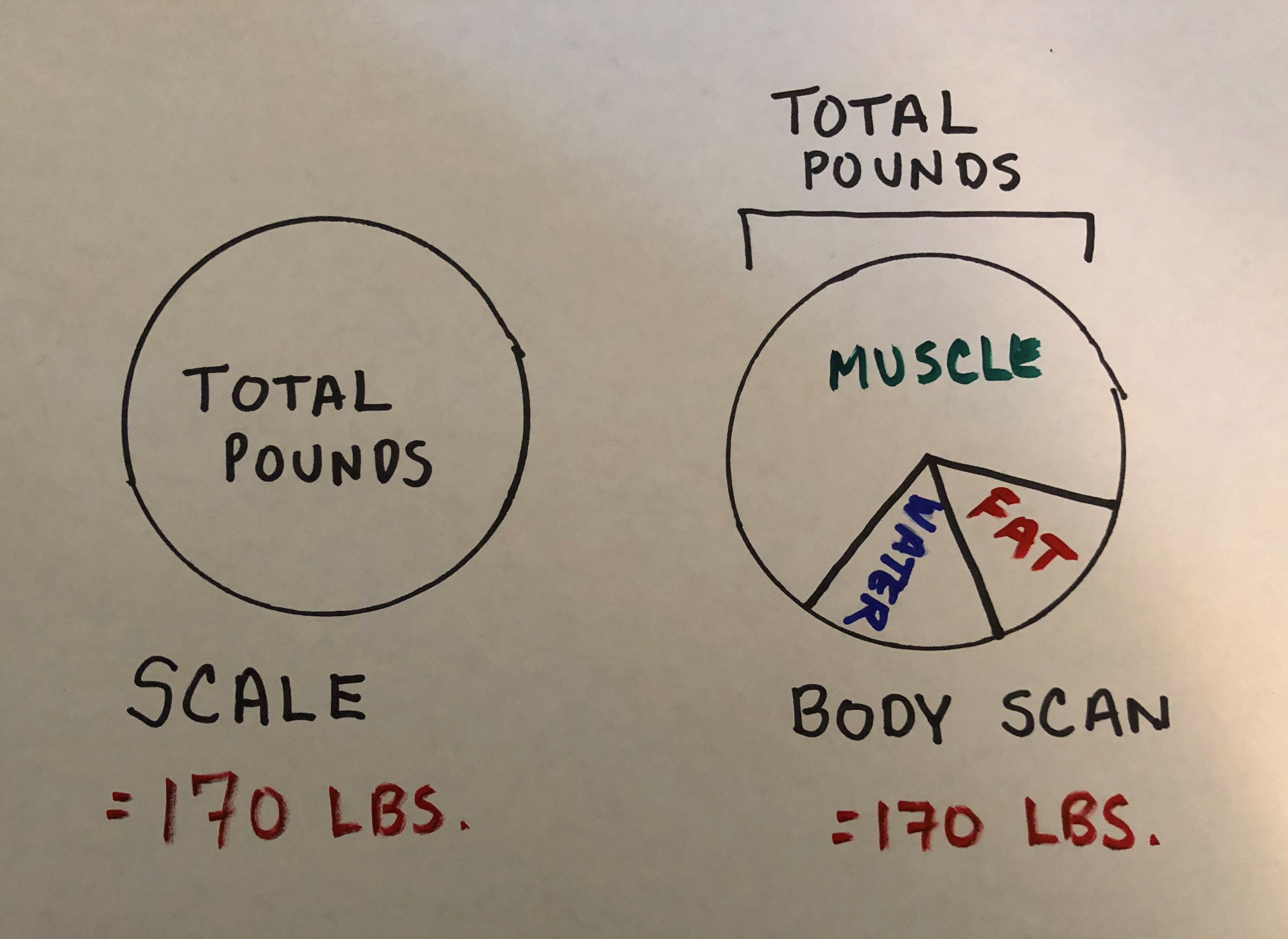
We have invested thousands of dollars to be able to provide this service complimentary to members because we believe it to be such an important part of understanding the body and how results happen.
The scale sucks. I used to say redeeming things about it like, “Well it can be okay” but that’s passive bullshit. The scale is awful. Ditch it. Measure better.
-Dave
Header image: Dr. Kelly Stone, PT
Tuesday, 1.26.21
PB & BAY PARK PSC
First:
10 Back Squat
10 Bilateral Rows
(x16 Min)
15′ AMRAP
10 DB Goblet Step Overs
14 Quadruped Shoulder Taps
80m Farmer Walk
OB PSC
First:
10 DB Front Squats
10 Bilateral Rows
(x16 Min)
15′ AMRAP
10 DB Goblet Step Overs
14 Quadruped Shoulder Taps
80m Farmer Walk